Researchers Reveal Where Centralized Wastewater Reuse Can—and Cannot— Ease Water Scarcity in China
Wastewater reclamation is increasingly regarded as an alternative water source to mitigate water scarcity. However, expanding centralized wastewater treatment capacity does not guarantee that reclaimed water will be effectively deployed in water-stressed regions. Real-world benefits of wastewater reuse rely on the spatial alignment of wastewater generation, collection capacity, reuse demand and local water scarcity.
A research team, led by Prof. SHEN Lei from the Institute of Geographic Sciences and Natural Resources Research, Chinese Academy of Sciences, conducted a systematic assessment on the effectiveness and economic viability of China’s centralized wastewater treatment systems for alleviating water scarcity. The study was published in Nature Water on Octorber 12.
The team compiled a national inventory of 10,826 wastewater treatment plants, integrating datasets on wastewater generation, sewer networks, reclaimed-water demand, water scarcity, infrastructure costs and multiple future socioeconomic SSP scenarios. Analyses reveal a severe spatial mismatch: wastewater supply, treatment capacity, water-scarcity pressure and economically feasible reuse demands are often geographically misaligned across China.
Under current conditions, only around 450 million people reside in areas where wastewater reuse can both recover costs and substantially alleviate local water stress. Reuse potential cannot be judged merely by wastewater output or plant size; it depends on the spatial coordination of supply, demand and water-shortage pressure.
The researchers define the economic-efficiency boundary for centralized wastewater treatment. At current wastewater treatment fees, plants generally require a capacity of 6,800-49,700 m³ per day to break even. Many unserved areas feature small wastewater volumes and scattered settlements. Forcing large-scale centralized systems in these locations requires lengthy sewer pipelines and fails to achieve scale economies. Reliance solely on centralized expansion reaches clear limits in both economic performance and water-scarcity mitigation.
They suggest site-specific planning: deploy centralized facilities where wastewater is concentrated, and adopt decentralized treatment for dispersed settlements. Modelling results show this hybrid strategy can meet national wastewater treatment and reuse targets with 25% -37% lower infrastructure costs compared with a purely centralized pathway. Cost savings stem mainly from avoiding long sewer networks in sparsely populated zones and uneconomical small-size centralized plants.
The findings show future wastewater infrastructure planning should shift from capacity-oriented expansion toward demand-driven system optimization, matching facility scale with local spatial patterns of population and wastewater.
Reference:
Shen, J., Shen, L., Zhong, S., Li, D., Li, D., Fang, J. & Bai, H. China’s Centralized Wastewater Treatment System Reaches Efficiency Limits in Tackling Water Scarcity. Nature Water (2026), https://doi.org/10.1038/s44221-026-00727.
Download attachments:

Prof. FU Zheng's team at the Institute of Geographic Sciences and Natural Resources Research, Chinese Academy of Sciences, in collaboration with international partners, found that plants can sustain transpiration at higher temperatures than photosynthesis under heat stress, revealing a thermal de...
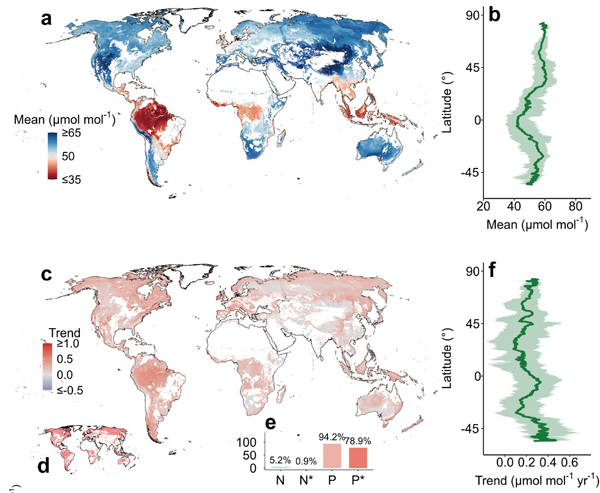
Prof. FU Zheng's team at IGSNRR in collaboration with international partners, developed a global isoscape of leaf carbon isotope discrimination for C₃ plants covering the period from 2001 to 2020.