Researchers Reveal a Global Picture of Changing Plant Water-Use Efficiency and Its Emerging Limits under Intensifying Water Stress
Intrinsic water-use efficiency (iWUE) reflects how efficiently plants assimilate carbon relative to water loss at the leaf level. Although widely studied using carbon isotope and gas-exchange measurements, most existing knowledge is derived from local observations. This has limited our understanding of how iWUE varies across different climates and ecosystems worldwide. Consequently, the global patterns of iWUE and its responses to water stress have remained poorly constrained.
To address this gap, Prof. FU Zheng's team at the Institute of Geographic Sciences and Natural Resources Research (IGSNRR), Chinese Academy of Sciences, in collaboration with international partners, developed a global isoscape of leaf carbon isotope discrimination for C₃ plants covering the period from 2001 to 2020. Based on this framework, the team quantified global patterns and long-term trends in leaf-level iWUE, examined the respective roles of atmospheric and soil drought, and evaluated the performance of an optimality-based ecological model. The study was published in Nature Communications.
Under the guidance of Prof. FU, postdoctoral researcher Dr. WANG Xiang found that iWUE is generally higher in cold and dry regions than in warm and humid regions, and that global mean iWUE has increased over the past two decades. Pronounced differences were observed among biomes: grasslands exhibit relatively high iWUE but slower rates of increase, whereas evergreen broadleaf forests show lower iWUE values but faster growth. iWUE typically increases with intensifying water stress, although this enhancement weakens under more severe stress conditions. Notably, vapor pressure deficit (VPD) was found to exert a much broader influence on iWUE than soil moisture.
The ecological optimality model successfully captured the large-scale spatial patterns of observed iWUE and confirmed VPD as the dominant driver of plant responses to water stress. However, the model tended to overestimate both absolute iWUE levels and their long-term increases.
Together, these findings provide a coherent global perspective on plant carbon–water relations and improve our ability to anticipate ecosystem responses to a warmer and drier future. They also suggest that intensifying water stress may limit further increases in plant water-use efficiency, with implications for the long-term stability of the terrestrial carbon sink.
As one international reviewer commented, “This study represents an important step forward in understanding plant water-use strategies at the global scale and offers timely insights into vegetation responses under accelerating climate change.”
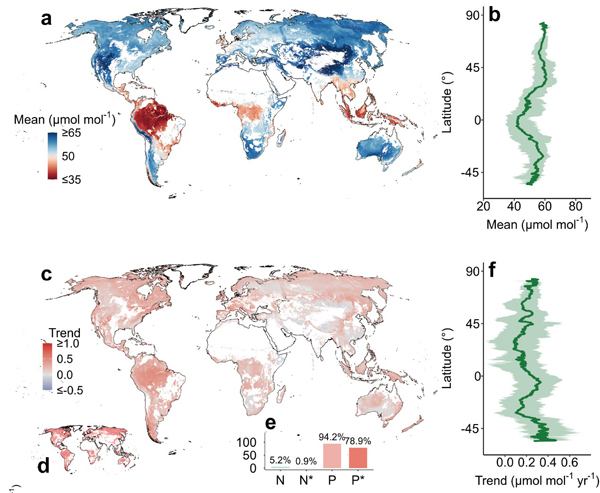
Fig.1 Global distribution and trend in leaf-level iWUE of C3 plants during 2001–2020 (Image by Prof. FU's team)
Reference
Wang, X., Fu, Z*., Ciais, P. et al. Global distribution and changes of leaf-level intrinsic water use efficiency and their responses to water stress. Nature Communications (2026). https://doi.org/10.1038/s41467-025-68252-9.
Download attachments:
Dr. Li Zhihui’s team and their collaborators present a framework for optimizing crop planting structures and spatial layouts, considering the water-land-energy-economy-environment-food nexus. Using the NSGA-II algorithm, the model addresses water and energy use, greenhouse gas emissions, economi...
Researchers led by Prof. FU Zheng at the IGSNRR, CAS, present the results of a new approach to quantify θcrit based on the diurnal amplitude of the land surface temperature and daily soil moisture measurements during periods of consecutive days without rain, using in-situ flux tower networks and...