Study Reveals Thermal Decoupling of Carbon Uptake and Water Loss in Terrestrial Ecosystems
Understanding how vegetation responds to temperature and coordinates carbon uptake with water loss is a central issue in global change ecology and Earth system science. While previous studies have mainly focused on the optimal temperature of photosynthesis, the thermal response of transpiration remains poorly constrained.
To address this gap, Prof. FU Zheng's team at the Institute of Geographic Sciences and Natural Resources Research, Chinese Academy of Sciences, in collaboration with international partners, found that plants can sustain transpiration at higher temperatures than photosynthesis under heat stress, revealing a thermal decoupling between carbon uptake and water loss in terrestrial ecosystems.
The study was published in Nature Plants on April 15.
Using global eddy covariance measurements, sap flow observations, remote sensing, and Earth system model simulations, the researchers systematically quantified the optimal temperatures of transpiration and gross primary productivity (GPP). The results show that the optimal temperature for transpiration is consistently higher than that for photosynthesis by approximately 1.8°C globally, with a more pronounced difference in forest ecosystems. As temperature increases, photosynthesis reaches its peak and declines earlier, whereas transpiration continues to increase over a broader temperature range, contributing to leaf cooling, until it decreases beyond its optimal temperature.
The study further demonstrated that, although the optimal temperatures of transpiration and GPP are positively correlated, they exhibit systematic divergence, indicating that ecosystem carbon uptake is more sensitive to high-temperature stress than water loss.
In addition, machine learning analysis identifies growing-season maximum temperature as the dominant driver of both optima, while their difference is primarily regulated by vegetation water content. Earth system models reproduce the general spatial patterns but significantly underestimate both the magnitudes and their differences.
The study provides the first global-scale evidence of divergence between the optimal temperatures of transpiration and photosynthesis and proposes a “dual optimal temperature framework” for understanding ecosystem carbon–water responses to warming.
This study underscores the urgent need to incorporate more realistic representations of plant physiological responses to warming to improve the reliability of climate projections and inform policy decisions related to water resource management and carbon emissions.
Reference:
Xia, H., Zhang, F., Ciais, P., Stoy, P.C., Peñuelas, J., Lian, X., Wang, Y., Makowski, D., Luo, Y., Niu, S., Yu, G., Huang, J., Wang, X., Zahn, E., Fu, Z.*, 2026. Higher optimal temperature for vegetation transpiration than for photosynthesis. Nature Plants, https://doi.org/10.1038/s41477-026-02263-2.
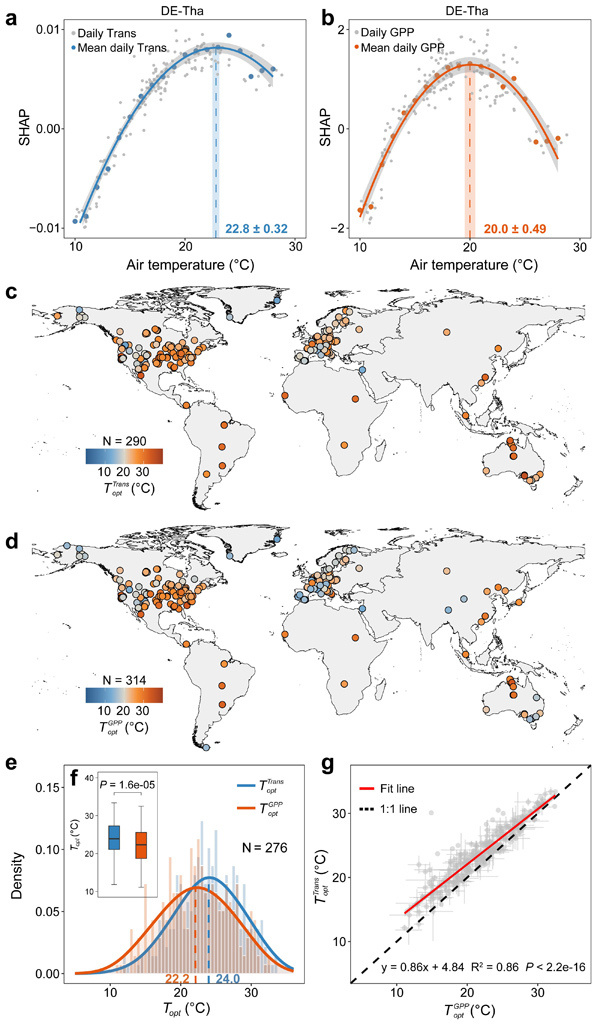
The optimal temperatures of transpiration and gross primary productivity from global flux tower observations. (Image by FU Zheng)
Download attachments:
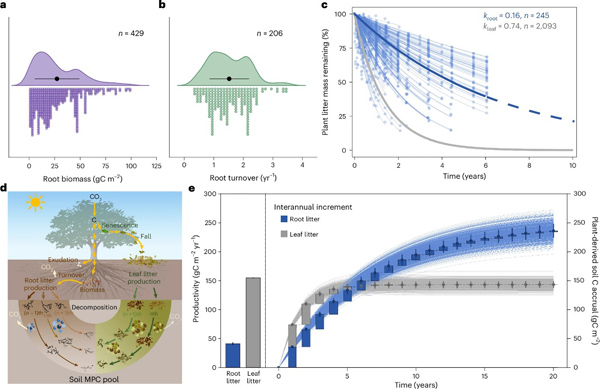
By synthesizing 880 observations from 199 woody species across 328 Northern Hemisphere forests, Professor KOU's team found that iterative effects of absorptive root contribute 2.4 ± 0.1 MgC ha-1 to the moderately-persistent forest soil C pool over two decades, exceeding that of leaves by 65%. Im...
Terrestrial ecosystem carbon cycle has attracted much attention because of their capacity to regulate atmospheric CO2 concentration and thus future climate warming. Prof. NIU Shuli’s lab at IGSNRR, CAS found that water availability determines terrestrial carbon fate and its feedback to climate w...