Why Do Stronger Winds Make Ecosystems Use Water Less Efficiently?
Wind does more than sway trees. It also affects how efficiently forests, grasslands and other ecosystems absorb carbon relative to the water they lose. A research team led by Prof. FU Zheng at the Institute of Geographic Sciences and Natural Resources Research, Chinese Academy of Sciences, has revealed a previously overlooked role of wind in regulating ecosystem water-use efficiency. The findings were published in Nature Climate Change.
Plants absorb carbon dioxide during photosynthesis while losing water through their leaves. Ecosystems also lose water through evaporation from soil and other surfaces. Scientists define "water-use efficiency" as the amount of carbon an ecosystem absorbs per unit of water lost. Understanding this balance is essential for predicting how ecosystems respond to climate change.
The researchers analyzed observations from monitoring sites worldwide, covering forests, grasslands, croplands and other ecosystems. Even after accounting for temperature, precipitation, solar radiation, atmospheric dryness and carbon dioxide concentration, they found that stronger winds were associated with lower water-use efficiency at nearly 80% of the sites. Across these sites, water-use efficiency showed a stronger median standardized response to wind speed than to the other environmental factors examined, highlighting its previously underappreciated importance.
But why does wind have such an effect?
Much like a breeze speeding up the drying of wet clothes, stronger winds remove moist air from around vegetation, allowing water to escape more easily into the atmosphere. The researchers found that declining water-use efficiency was driven mainly by increased evapotranspiration, with reduced gross primary productivity playing a smaller role. Evergreen needleleaf forests and ecosystems in humid regions were particularly sensitive to changes in wind speed.
Using Earth system models, the team further found that future changes in wind speed could substantially influence ecosystem water-use efficiency, although the magnitude of this effect varies across climate scenarios.
These findings highlight wind speed as an important yet often overlooked factor in the global carbon and water cycles. As wind patterns continue to change, better accounting for their effects on ecosystem carbon uptake and water loss could improve Earth system model predictions of how terrestrial ecosystems respond to future climate change.
Reference:
Wang, X., Peñuelas, J., Ciais, P., Du, C., Smith, W., He, P., Feng, H., Wu, C., Yu, K., Zeng, Z., Xiao, J., Ren, S., Chen, G., Li, X., Zhang, Y., Wang, S.H, Wang, T., Wang, S., Zhang, Q., Fu, Z.*. 2026. High wind speed reduces water use efficiency across terrestrial ecosystems. Nature Climate Change. https://doi.org/10.1038/s41558-026-02781-z.
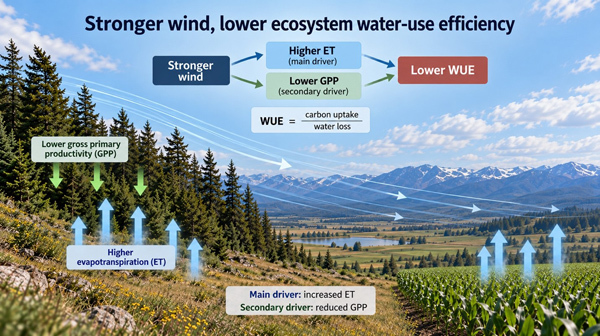
Schematic illustration of how stronger winds reduce ecosystem water-use efficiency. (Image by FU Zheng’s team)
Download attachment: