Researchers Reveal Dual Roles of Human Activity in Shaping Global Fire Regimes
Fire is a major disturbance affecting ecosystems, climate, and human society. However, it remains difficult to separate the effects of human behavior on fire activity from those of weather and climate. A research team led by Prof. WANG Jianghao and Prof. GE Yong from the Institute of Geographic Sciences and Natural Resources Research of the Chinese Academy of Sciences found that human activity plays dual and opposing roles in global fire regimes. Reduced human activity lowers fire incidence in many regions by limiting ignition, but it can increase fires elsewhere by weakening prevention and suppression. This work was published in Cell Reports Sustainability.
Weather, vegetation, and topography influence the timing and spatial distribution of fire occurrence.. Human activity also has complex effects. People may ignite fires accidentally, conduct prescribed burning, or use fire for land management. Meanwhile, they prevent and suppress fires through monitoring, firefighting, and other management practices.
The sharp decline in human mobility during the COVID-19 pandemic provided an opportunity to distinguish these different effects. Under the guidance of Prof. WANG Jianghao and his colleagues integrated satellite fire observations, meteorological records, lockdown policies, and human mobility data. They compared global fire activity during the first half of 2020 with the corresponding historical baseline from 2013 to 2019.
After accounting for weather and other factors, they found that mobility restrictions were associated with an average 12.3% decline in global fire incidence. However, the responses varied greatly among regions. Fire incidence declined in southeastern China, the southeastern United States, northwestern Africa, and many parts of Oceania. In contrast, it increased in parts of South America, southern Africa, and Northeast Asia.
Further analyses showed that fire incidence decreased by 27.7% in forests and 8.4% in grasslands. Larger reductions also occurred in areas with lower human footprints and locations farther from the wildland–urban interface. These patterns suggest that human ignition is an important driver of fires in less-developed landscapes.
Reduced human activity also changed fire seasonality. An early decline in fires could allow vegetation fuels to accumulate and delay the fire season. In contrast, an early increase could consume fuels sooner and advance the fire season.
These findings show that uniform fire policies may not work everywhere. Fire management should reflect local human–fire relationships, reduce accidental ignitions, maintain necessary suppression capacity, and preserve beneficial prescribed-burning programs.
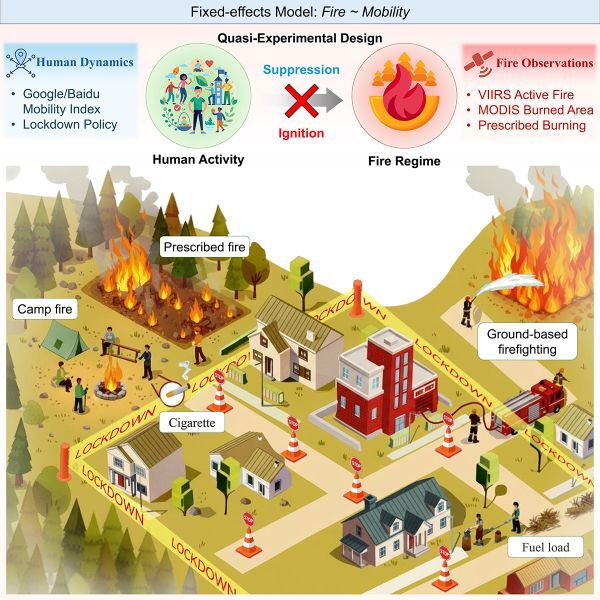
Figure. Human activity affects global fire regimes through two opposing pathways. Human can increase fire activity through accidental or intentional ignition, while reducing fires through prevention, suppression, and management. Mobility restrictions during the COVID-19 pandemic revealed strong regional differences between these effects. (Image by Prof. WANG Jianghao’s group)
Reference:
WANG J., ZHANG Z., GUO Y., CHENG Z., and GE Y. Unraveling the dual roles of human activity in shaping global fire regimes. Cell Reports Sustainability, 2026, 3: 100860, https://doi.org/10.1016/j.crsus.2026.100860.
Download attachment: