New Study Reveals Global Models Overestimate Increases in River Flow under Climate Change
Understanding how water moves through the Earth system is fundamental for predicting climate impacts and ensuring sustainable water management. Yet, despite decades of research, major uncertainties remain in how global precipitation is partitioned into evapotranspiration and river flow—the two dominant pathways of water return from land to the atmosphere and oceans.
A new study led by Prof. ZHANG Yongqiang of the Institute of Geographic Sciences and Natural Resources Research, Chinese Academy of Sciences, provides the most observation-constrained assessment to date of the global water cycle. The paper, now published in Nature Geoscience, combines satellite-derived hydrological estimates, multi-model Earth system simulations, and long-term observations from 50 large river basins worldwide using an advanced Emergent Constraint framework.
The team found that global river flow is significantly lower—by roughly 14%—than the central estimates of current Earth system models, while global land evapotranspiration is correspondingly higher. Their analysis shows that from 1980–2014, global river flow averaged 39.1 ± 5.4 × 10³ km³ per year, with a global runoff coefficient of 0.35 ± 0.03, both of which fall below widely cited values (Figure 1).
Looking to the future, the researchers reveal that Earth system models systematically overestimate increases in global river flow under warming. The new constrained estimate suggests that river flow will rise by 7.8 ± 5.5 mm per year per degree of global warming—about 9% lower and 66% less uncertain than the multi-model mean. Similar overestimations were found for ocean precipitation and evaporation.
“Our study shows that global models tend to exaggerate how much river flow will increase in a warmer world,” said Prof. ZHANG. “By integrating real-world observations, we provide a more realistic and robust estimate of how the global water cycle is partitioned, both now and in the future.”
Co-author Prof. Günter Blöschl, a leading hydrologist, emphasized the significance of the findings: “This work provides the first globally consistent benchmark for water cycle partitioning. It highlights the essential role of human impacts in shaping global river flow, something many models still fail to capture adequately.”
The results carry important implications for improving climate model projections, refining global water resource assessments, and guiding long-term adaptation strategies. As Prof. Zhang notes: “Reliable water cycle projections are foundational for anticipating droughts, floods, and water scarcity. This study brings us one major step closer.”
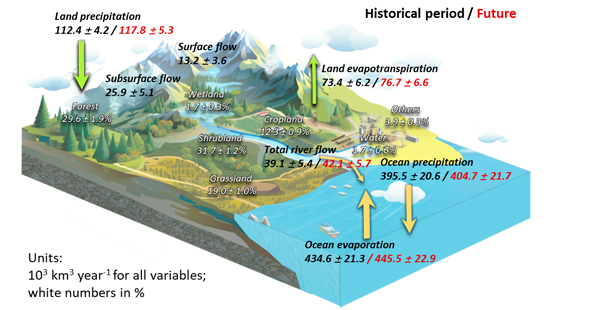
Figure 1: Partitioning of the global water cycle using the Emergent Constraint approach (Image by Prof. ZHANG Yongqiang's team)
Reference:
Zhang Yongqiang, Blöschl Günter, Wei Haoshan, Kong Dongdong, Ma Ning, Wagener Thorsten, Tian Jing, Xia Jun, Li Congcong, Wang Longhao, Chiew Francis H.S., Leung L. Ruby, Liu Xingcai, Zheng Hongxing, Zhang Xuanze, Liu Changming. Overestimation of past and future increases in global river flow by Earth system models. Nature Geoscience. 2025. doi: 10.1038/s41561-025-01897-9.
Download attachment: