How Long Do We Need to Watch Nature to See Biodiversity’s Full Effect on Ecosystem Stability?
Over the past decades, ecological experiments have shown that biodiversity enhances ecosystem stability under environmental disturbances, profoundly shaping global awareness of the importance of biodiversity conservation. Yet one fundamental question has remained unresolved: Does the relationship between biodiversity and ecosystem stability depend on how long ecosystems are observed? This issue has drawn increasing attention and debate, particularly as long-term biodiversity experiments, such as the Cedar Creek experiments in the U.S. and the Jena Experiment in Germany, have recently revealed that plant diversity’s effect strengthens over time. Until now, however, this pattern has never been empirically demonstrated in natural ecosystems.
Prof. NIU Shuli’s team at the Institute of Geographic Sciences and Natural Resources Research (IGSNRR) of the Chinese Academy of Sciences (CAS), together with international collaborators, conducted a 4,200-km-long survey across the alpine grasslands of the Tibetan Plateau. They combined the regional data with global datasets on plant diversity and productivity, providing the first evidence that biodiversity’s stabilizing effects change over time in natural ecosystems. This research was published in Nature Plants.
Under the guidance of Prof. NIU, Associate Prof. ZHANG Ruiyang identified a clear and consistent temporal pattern across regional and global scales. The stabilizing effect of plant diversity on ecosystem productivity grew stronger with longer observation periods and reached saturation at roughly 10–13 years. This decadal threshold is crucial because longer time series capture climate-driven population and community fluctuations that short-term studies cannot detect.
As one international peer commented “This finding is a very important extension of the similar results from the manipulated experiments of diversity gradients, and thus is a crucial step towards deeply understanding the complex linkage between biodiversity and stability in the long-time scale. Their findings are both timely and touches in the context of current rapid global change and the resultant biodiversity loss.”
The study also sheds light on a major scientific debate: Which dimension of biodiversity matters most for long-term ecosystem stability? The team found that phylogenetic diversity, the evolutionary divergence among coexisting species, was the strongest predictor of long-term stability, explaining up to 36.2% of the variation, outperforming taxonomic diversity, functional diversity, and even environmental factors. This underscores phylogenetic diversity as a key, representative dimension of biodiversity that sustains ecosystem functioning over decades.
These findings underscore the need for at least decade-long ecological observations to fully understand how biodiversity stabilizes ecosystems under real-world environmental variability. Without such long-term data, the stabilizing role of biodiversity may be underestimated, hindering efforts to design effective conservation and restoration strategies in a rapidly changing world.
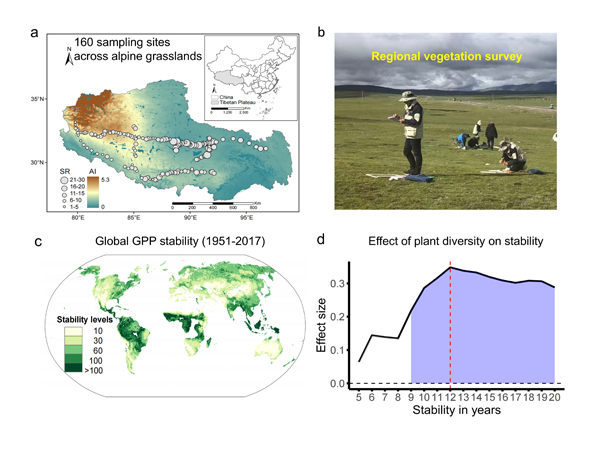
Fig. Temporal dynamics of plant diversity–ecosystem stability relationships across scales. (a) Distribution of 160 field sampling sites in the alpine grasslands of the Tibetan Plateau. (b) Photograph of researchers conducting field vegetation survey. (c) Global pattern of gross primary productivity stability (1951–2017). (d) Increasing effect of plant diversity on ecosystem stability with longer observation timescales. (Image by NIU Shuli’s team)
Reference:
Zhang R., Su C., Wang Y., Wang S., Tian D., Wang J., Jiang L., Chen X., Zhu J., Pan J., Zhao G., Quan Q., Yan P., He Y., Li Y., Song L., Peng J., Yan Y., He Y., Wei X., Niu S.*. Decadal-scale observations are key to detecting the stabilizing effects of plant diversity in natural ecosystems. Nature Plants. (2025).
Download attachment: