Researchers Reveal Armed Conflict Accelerates Global Cropland Loss
Armed conflict is widely recognized as a major driver of food insecurity, but its long-term effects on cropland have remained poorly understood at the global scale. A research team led by Prof. LI Guangdong, Dr. QI Wei and Prof. WANG Zhenbo from the Institute of Geographic Sciences and Natural Resources Research, Chinese Academy of Sciences, has provided global evidence that armed conflict accelerates cropland loss and can substantially constrain agricultural production. The study was published in Nature Food.
The researchers combined annual 30-m-resolution global cropland maps from 2000 to 2020 with more than 460,000 georeferenced armed conflict events across 155 countries. They examined cropland changes within 5 km of conflict locations and used difference-in-differences and propensity score matching approaches to distinguish conflict-related changes from broader environmental and socioeconomic trends.
The study found that areas exposed to armed conflict covered only about 3% of the global land area yet contained more than 6% of the world’s cropland in 2020, demonstrating that agricultural land was disproportionately exposed to conflict. While global cropland witnessed an overall expansion between 2000 and 2020, cropland within conflict-affected areas exhibited a slight decline over the same period.
Further analysis showed that armed conflict caused an average 3.01% reduction in cropland area, equivalent to an annual loss of 14.46 hectares per conflict-exposed buffer. The effects persisted for many years after conflict onset. A complementary spatial comparison showed that conflict-affected areas experienced 23.7% greater cropland loss than otherwise comparable non-conflict areas. The most substantial losses were concentrated in Western Africa, Eastern Africa and Southeast Asia.
The effects were also strongly dependent on the intensity and duration of conflict. Areas experiencing very frequent conflict showed particularly severe cropland losses, with the highest-frequency group losing about one-third of its cropland. Protracted and high-severity conflicts were associated with much greater losses than intermittent or low-severity conflicts. By contrast, areas entering post-conflict peace showed no clear evidence of continued cropland decline.
The researchers also found that conflict-related cropland losses were shaped by broader social and institutional conditions. Losses tended to be greater in countries with higher levels of refugee displacement, with a similar pattern observed for food insecurity. By contrast, higher scores for government effectiveness, regulatory quality and the rule of law corresponded to smaller losses. These findings suggest that institutional capacity may help buffer agricultural systems against the effects of conflict.
To assess the implications for food production, the research team translated cropland losses into potential crop production and dietary energy. After accounting for cropland gains and losses related to urban expansion, conflict-affected areas lost approximately 249,667 km² of cropland between 2000 and 2020. The crops that could have been produced on this land were estimated to provide sufficient dietary energy to satisfy the minimum annual requirements of about 255.54 million people. The researchers emphasize that this figure represents forgone production potential rather than actual food consumption or realized food insecurity, which also depend on trade, prices, distribution and access.
The study highlights that the agricultural consequences of armed conflict are highly uneven across space and depend on conflict frequency, persistence, severity and institutional context. The findings point to the importance of monitoring conflict and cropland change together and of integrating short-term humanitarian responses with longer-term efforts to restore agricultural infrastructure, support farmers and strengthen local institutions in conflict-affected regions.
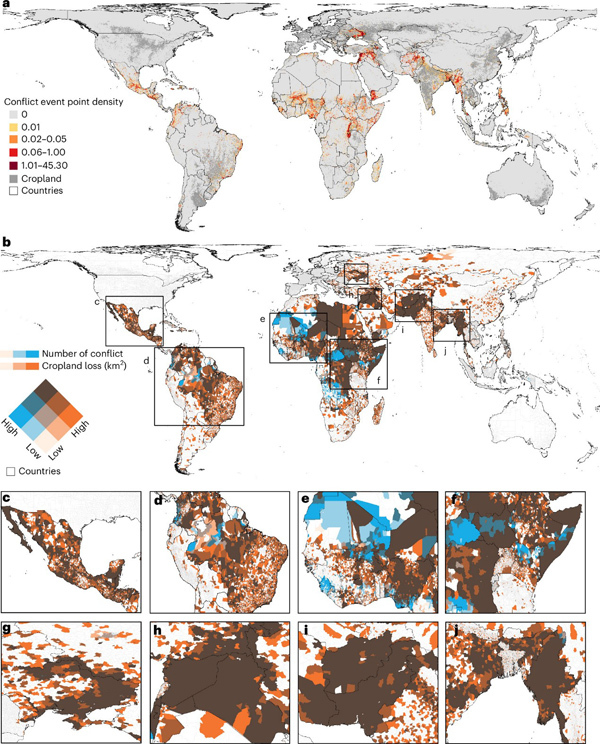
Figure: Spatial overlaps between global armed conflict events and cropland loss. (Image by: LI Guangdong’s research team)
Li, G., Qi, W., Sun, S., Liu, X. & Wang, Z. Armed conflict accelerates cropland loss and food insecurity worldwide. Nature Food (2026). https://doi.org/10.1038/s43016-026-01436-8.
Download attachments:
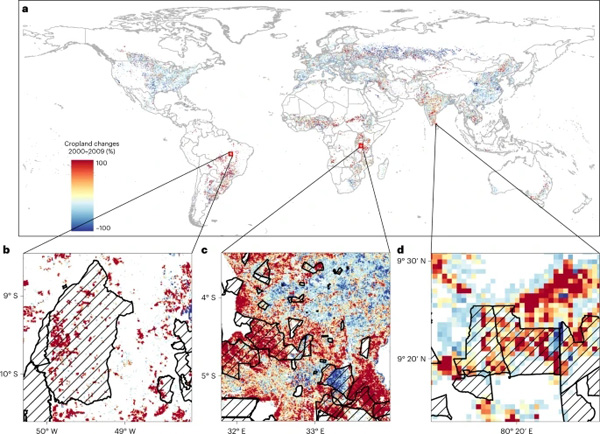
Protected areas (PAs) are essential for biodiversity conservation but are threatened by cropland expansion. Recent studies predicted that approximately 500 million ha of additional croplands will be required in 2050 to address global food demand, which will increase pressure on natural habitats. ...
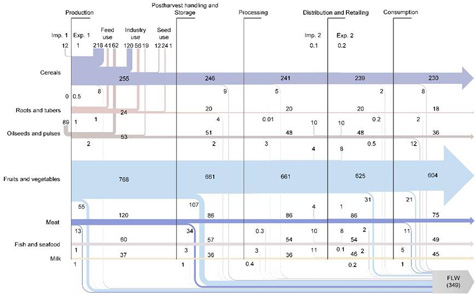
Food loss and waste (FLW) has become a worldwide concern in recent years and is widely identified as a key barrier to food security, human health, and environmental sustainability.