Study Provides a Plant-microbe Co-driven Perspective on the Nitrogen Cycle
For decades, scientists have viewed the terrestrial nitrogen (N) cycle mainly as a process controlled by soil microorganisms, while plants were considered passive users of the N made available by microbes. However, this traditional view cannot fully explain several important ecological puzzles, such as why N use efficiency declines under long-term fertilization or why rising atmospheric CO2 often fails to relieve N limitation in plants. One key reason is that the current theories largely overlook the fact that plants continuously supply carbon to the soil through photosynthesis, thereby influencing the activity of surrounding microorganisms.
In a study published in Trends in Plant Science, XU Xingliang and LIU Min from the Institute of Geographic Sciences and Natural Resources Research, Chinese Academy of Sciences (CAS), propose a new framework that views the N cycle as a process jointly driven by plants and microorganisms.
Instead of treating plants as passive recipients of soil nutrients, the researchers argue that plants actively regulate N cycling in the rhizosphere—the narrow zone of soil surrounding roots. Microorganisms remain the main agents that transform different forms of N, but plants direct where, when, and how these transformations occur by controlling the supply of carbon released from their roots. In this way, plants and microbes work together to match N availability with plant growth.
The new framework is built on the concept of the Root Economics Space (RES), which describes how plants balance carbon investment with N acquisition. According to the study, plants can adopt two complementary strategies depending on nutrient availability. When mineral N is readily available, plants mainly use a "Do-It-Yourself (DIY)" strategy by investing carbon in root growth, increasing root branching, and producing more N transporters to absorb nutrients directly from the soil. When N is locked in organic matter, plants switch to an "Outsourcing" strategy. Instead of investing primarily in root growth, they release carbon-rich compounds from their roots to recruit beneficial microorganisms. These microbes break down organic matter and release N that plants can absorb.
The researchers show that this co-driven framework provides a new way to understand ecosystem responses to global environmental change. Rising atmospheric CO₂ supplies plants with more carbon, allowing them to invest more in microbial partners and improve N acquisition in nutrient-poor soils. In contrast, long-term N deposition reduces the need for these partnerships. As plants invest less carbon belowground, communication between plants and microbes weakens, leading to lower N use efficiency and greater N losses to the environment.
The study also highlights practical opportunities for improving sustainable agriculture. Rather than relying mainly on synthetic fertilizers, future strategies could strengthen natural plant–microbe cooperation. These include breeding crop varieties with stronger abilities to regulate soil microbes, developing beneficial microbial communities tailored to different crops, and adopting soil management practices that enhance plant–microbe interactions. Together, these approaches could improve N use efficiency while reducing environmental pollution and supporting climate-resilient agriculture.
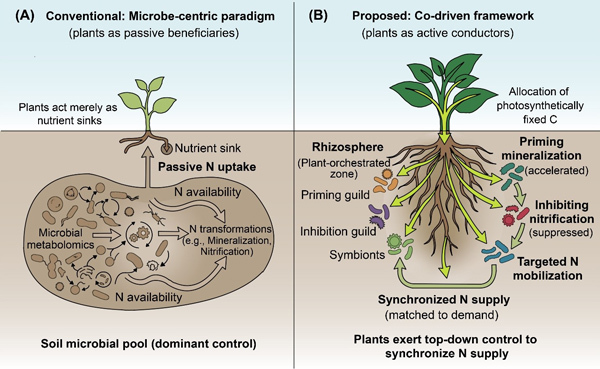
Fig. 1 A paradigm shifts from a conventional microbe-centric view to a plant-microbe co-driven nitrogen (N) cycle. (Image by LIU Min and XU Xingliang)
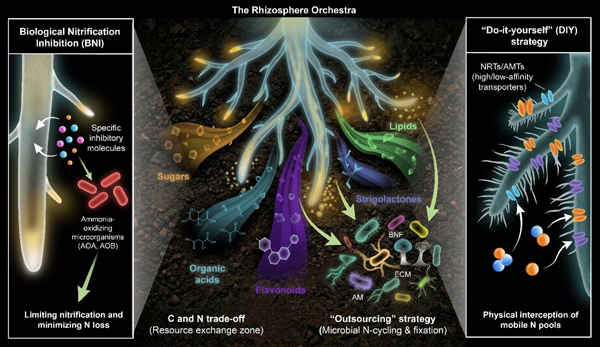
Fig. 2 The rhizosphere orchestra on nitrogen (N) cycling: mechanisms of chemical “Outsourcing” versus physical “Do-it-yourself (DIY)” foraging. (Image by LIU Min and XU Xingliang)
Download attachments:
Eutrophication refers to excessive enrichment of nutrients such as nitrogen and phosphorus in waterbodies and it poses a severe challenge to aquatic ecosystems. For instance, it may lead to excessive algal growth, thus having significant impacts on human and ecosystem health. Nitrogen transport f...
China is one of the three regions with the highest N (Nitrogen) deposition in the world. Better understanding of the spatio-temporal pattern of N deposition is critical for environmental management and policy development.