Study Reveals Concurrent Fire Seasons Overwhelm International Aid Capacity
An international collaborative study shows that synchronous fire weather, days when extreme fire weather occurs across regions at the same time, has increased strongly worldwide since 1979. In many regions, the number of these synchronous high-risk days has more than doubled. The study also finds that when these widespread high-risk days occur, they tend to align with more fire activity and worse air quality in several regions, meaning the most dangerous fire conditions are increasingly happening "all at once," not just locally.
This study is published in Science Advances on February 18 2026. Professor WANG Juanle and Associate Professor LIU Yangxiaoyue from Institute of Geographic Sciences and Natural Resources Research (IGSNRR), CAS contributed to this work. Dr. YIN Cong (a PhD graduate at IGSNRR, now a postdoc scientist) and Professor John Abatzoglou from University of California, Merced led this work. Collaborators also include Dr. Matthew Jones from the University of East Anglia, Professor Alison Cullen from the University of Washington, and Associate Professor Mojtaba Sadegh from Boise State University.
When extreme fire weather happens in many places at once, it increases the likelihood of widespread fire outbreaks and strains firefighting capacity, because crews, aircraft, and equipment can’t be easily shared when everyone needs help simultaneously. This also raises the risk of severe smoke episodes that harm health. A key takeaway is that growing overlap in fire-danger seasons can shrink the "window" when countries or regions can effectively support each other. For example, the United States and South Africa average 4 same-day extreme fire weather days per year, increasing by 1.2 days per decade.
The researchers used global weather reanalysis data to calculate the daily Fire Weather Index (FWI) from 1979 to 2024. They defined "extreme" days as the top 10% of FWI at each location, then tracked when these extremes covered large areas or occurred in multiple regions at the same time.
To separate human-driven climate change from natural variability, the team repeated the analysis after removing the long-term warming signal estimated by climate models, which approximates a world without human-caused warming. In addition, they examined the role of natural climate variability, such as El Niño and compared these synchronous patterns with burned area and smoke pollution (PM2.5) to estimate real-world impacts.
Yin, C., Abatzoglou, J. T., Jones, M. W., Cullen, A. C., Sadegh, M., Wang, J., & Liu, Y. (2026). Increasing synchronicity of global extreme fire weather. Science Advances, 12(8), eadx8813.
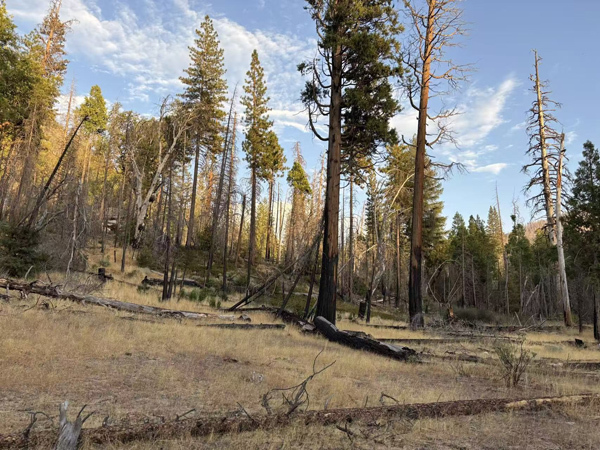
Forests after fire. Photographed on October 8, 2024 (Image by YIN Cong)
Download attachments:
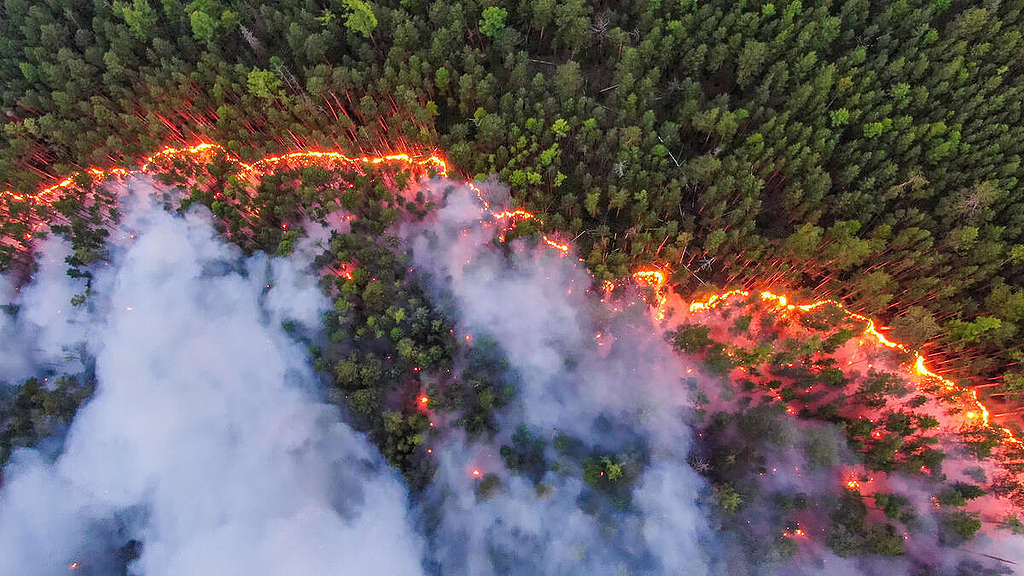
The study show that after 2010, the median severity of large wildfires surged by 42.9 percent in arid regions and 54.3 percent in boreal zones, with North America's western regions, northern-central Siberia and southeastern Australia being hardest hit.
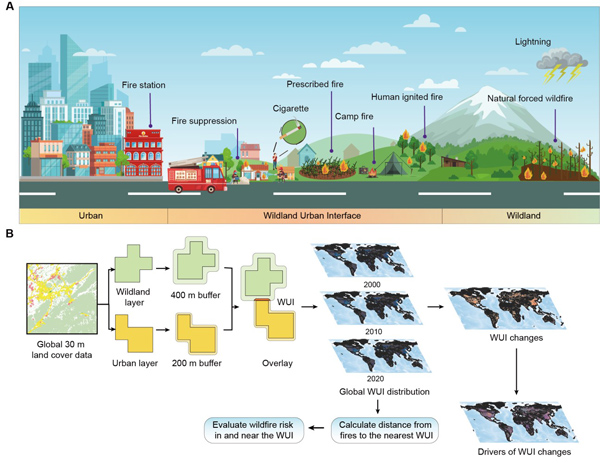
The wildland-urban interface (WUI) is where the risk of exposure to natural hazards such as wildfire is most pronounced. Prof. WANG Jianghao’s team at the Institute of Geographic Sciences and Natural Resources Research (IGSNRR) of Chinese Academy of Sciences reveals the rapid global growth of th...